The situation
In 2023, generative AI landed in enterprise software all at once — and every product team wanted to bolt on a chatbot. NetSuite, an ERP used by tens of thousands of companies, faced the classic risk: a dozen teams shipping a dozen inconsistent AI experiences into financial workflows where a wrong click has real consequences.
The Global/AI UX discovery project existed to prevent that. The goal wasn’t to ship one AI feature — it was to answer, once, the questions every team was about to answer differently: when should AI appear, where should it live in the interface, and what components make it feel like one product.
The framework: two questions before any screens
Instead of starting from screens, we started from an interaction model built on two axes:
- Initiation — does the system start the interaction (proactive, contextual help), or does the user (asking for something)?
- Placement — does the AI live immersive (a full-screen conversational workspace), beside the work (a companion panel), inside it (assistance within a field or form), or invisible (working in the background, surfacing only results)?
That matrix produced seven named AI UX patterns, from full-screen conversational experiences down to lightweight and background assistance. The power of the taxonomy is what it does to roadmap conversations: a team proposing an AI feature no longer starts with “let’s add a chat window” — they locate their scenario in the matrix and inherit the right pattern. Writing assistance inside a field, anomaly detection running invisibly, an assistant beside the workflow: all one system, not three inventions.
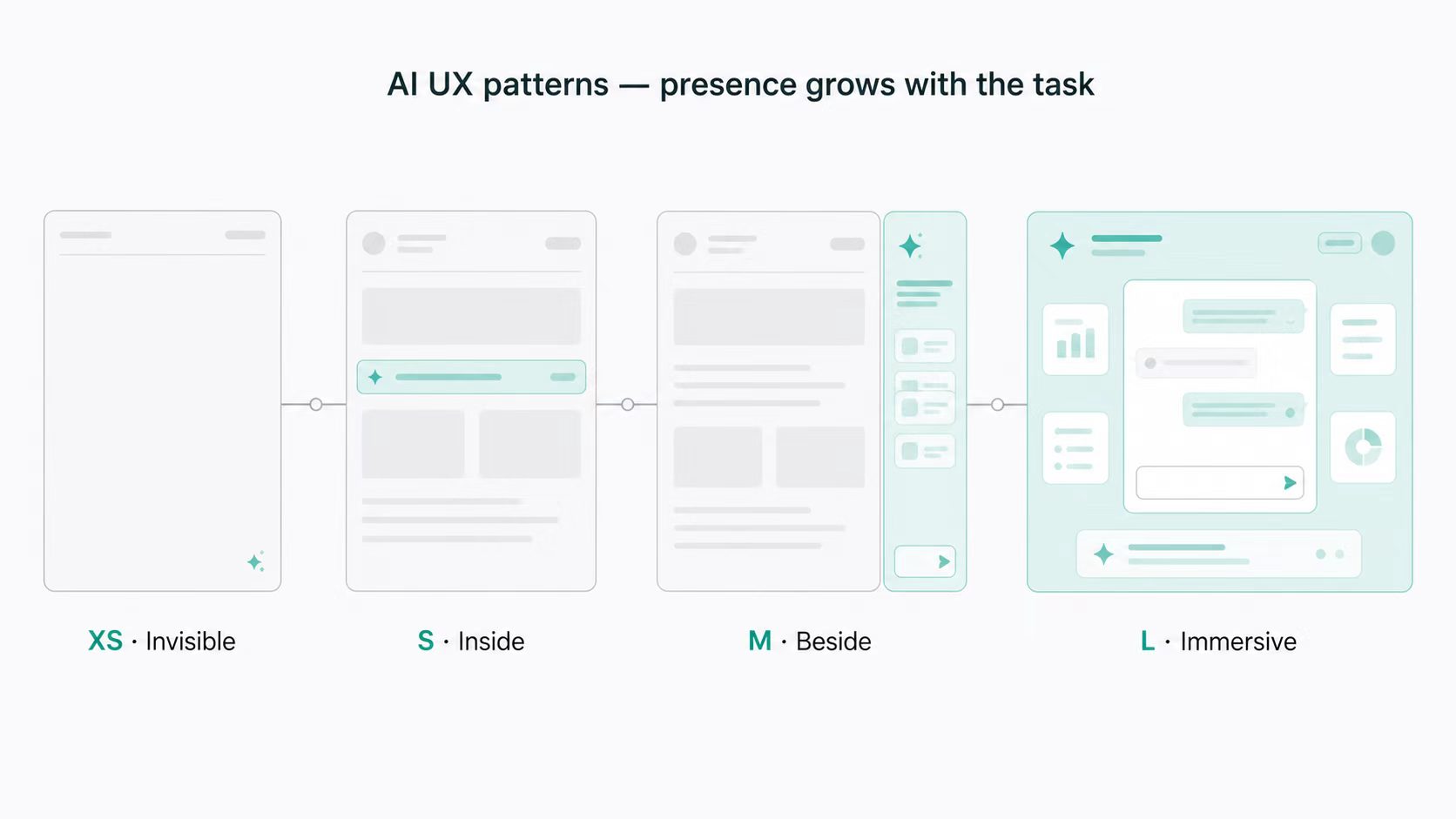
The placement axis, illustrated: AI’s presence grows with the task — from invisible background work to a fully immersive workspace. Recreated for this portfolio; the original NetSuite documents are confidential.
From framework to practice
A taxonomy nobody can build from is a poster. The discovery brought together everything needed to make the model usable:
- User goals and “shape of data” mapping — which user problems AI can credibly help with, and what the underlying data looks like for each. In an ERP, the data’s shape decides what the AI can honestly promise — this grounding killed several attractive but unbuildable ideas early.
- Idea prioritization across scenarios, so the patterns targeted the workflows that mattered.
- An interim AI UX design system — reusable patterns and draft UI components organized by the four placements (Invisible, Inside, Beside, Immersive), aligned with the next-generation design language.
- A conversational UI prototype plus brand exploration for how the assistant should present itself.
Throughout, I synced regularly with the teams building AI features so the emerging standards and the shipping products pulled in the same direction — and I mentored a designer through the discovery, because patterns that live in one person’s head don’t survive that person’s vacation.
Proving it on the biggest stage
The “Ask Oracle” exploration became NetSuite Assistant in Global Search — a prototype I co-created that was demoed in a SuiteWorld 2024 keynote: conversational assistance woven into the product’s core navigation rather than bolted on beside it.
Outcome — and an honest status
- A reusable conversational-AI framework: seven patterns with a shared vocabulary that product teams reference instead of designing AI interactions from scratch.
- An interim AI UX design system carrying the patterns into components.
- A keynote-stage prototype demonstrating the immersive end of the framework.
- The pattern thinking flowed directly into shipped AI features — Text Enhance (the “inside” pattern) and Prompt Studio among them.
This was discovery work, and I present it as such: a foundation, deliberately built before the features — not a shipped experience claiming retroactive strategy.
Her design work was “crucial for the successful launch of NetSuite AI products.”
— Senior design manager, Oracle (performance review)What I learned
AI patterns age faster than form patterns. The framework we drew in year one needed revisiting within months as the models improved — governing a living pattern library matters more than any first version of it. And in AI strategy work, the most valuable artifact isn’t a screen: it’s a shared vocabulary. Once seven patterns had names, every roadmap conversation across teams got shorter.